“One looks back with appreciation to the
brilliant teachers, but with gratitude to those who touched our
human feelings. The curriculum is so much necessary raw material,
but warmth is the vital element for the growing plant and for the
soul of the child”-Carl Jung
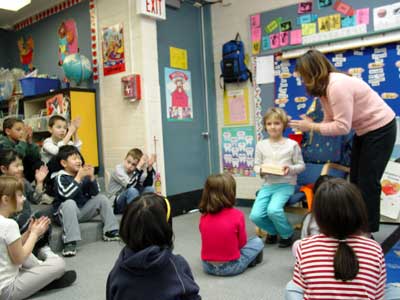
My family and I moved to the United States from the Philippines
in April of 1986. I was just five years old at the time, unaware
of the drastic change that had occurred in my family’s lives.
My brothers and I attended school until the end of the school year,
however, I do not remember much of my kindergarten classroom. One
of my first memories of school in the United States was my first
grade teacher, Mrs. Christiansen. It was an exciting moment of
my life, entering first grade. I remember standing in front of
my classroom with my mother, holding her hand tightly while clutching
my pink “My Little Pony” lunch pail in the other hand.
Arriving at the new school, I remember looking around in wonder
and amazement at all the brightly decorated walls. Mrs. Christiansen
was waiting by the door welcoming all her new students inside.
My brothers and I had all attended an English-taught elementary
school in the Philippines so our English was fluent. Like many
second language students who may be timid in expressing themselves
vocally, I was quiet during my first exciting day of school. Mrs.
Christiansen had filled the day with many activities including
Curious George and Clifford lessons, games, and touring the school.
As the days passed, I remember sitting down in a circle and talking
about ways that we could all be friends in one classroom. I felt
comfortable and at ease to be myself around these strangers. This
fond memory remains vivid, and from this moment on, I decided that
I wanted to become a teacher. Not just a teacher---but a teacher
who was just like Mrs. Christiansen.
Almost 18 years later, I experienced
a similar situation during my September experience in my future
student teaching classroom.
My cooperating teacher reminds me of Mrs. Christiansen. She welcomed
all her students at the door every day and she planned days that
were filled with many engaging activities, that welcomed all
the students into this community. Both Mrs. Christiansen and my
cooperating
teacher created and provided a caring and nurturing environment
in which all students could grow and develop. Mrs. Christiansen’s
class, like my cooperating teacher’s classroom was very
diverse, and these two teachers established a positive learning
environment
from the very beginning of the school year. These early experiences
in my own education, as well as the environment that was established
in my student teaching classroom, have planted and nurtured the
seeds of my core teaching beliefs.
I believe that being an educator
is a moral endeavor. As Carl Jung states in the above quote,
a teacher’s warmth encourages
students to grow and develop. As a teacher, the relationships
that I establish with my students are crucial in supporting their
emotional
and academic growth. As a teacher, I have the responsibility
of not only teaching children well, but also teaching children
to
become active, participating citizens in our society. My elementary
classroom will serve as a platform for this teaching and learning.
As my principal states, “Elementary school is very much
a social and emotional developmental process as well as one of
academic
growth. As a learning community of students, parents and staff,
we are all responsible for making the community supportive for
all areas of growth,” (Peiffer, 2004). As a teacher, my
classroom will be an environment that adapts for all my students’ individuality,
an environment in which my students develop character and form
a community in which their voices are heard and appreciated.
Thus, my three guiding beliefs as a teacher are: creating a safe
a positive
learning environment; recognizing and respecting my students
as individual learners and having engaging, challenging and purposeful
instruction.
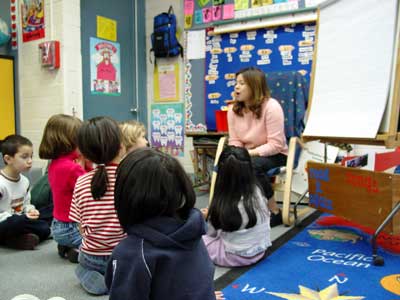
Creating a safe and positive environment.
 |
I believe that in order
for any type of learning to occur, children first and foremost
must feel comfortable and safe. I will strive
to create a positive learning environment that encourages my
students to work effectively as individuals and in groups.
My future classroom will promote supportive social interactions,
collaboration, active engagement in learning, and self-regulated
learning. Children must feel that their classroom is a place
where they belong, as they feel supported by their peers when
they take risks and contribute to discussions. One of my responsibilities
as a teacher is to provide an environment in which students’ basic
needs are met. Jones and Jones (2001) write, “Students
behave appropriately and learn more effectively in environments
that meet their basic personal and psychological needs. All
students learn best in school settings in which they are comfortable
and
feel safe and accepted” (Jones and Jones, 2001, p. 125).
I will create a physical environment that allows students to
feel
safe to participate. For example, my students will be seated
in groups
to foster a collaborative and cooperative environment. I feel
that students learn so much from another that it is crucial
for them to be able to interact with one another to foster
this learning.
Additionally, I believe that students are able to develop emotionally
through their social relationships with peers.
During my student
teaching experience, I was able to observe first hand how teachers
can establish a nurturing learning community.
According to Sapon-Shevin (1999), “A nurturing community
is a place where it is safe to be yourself. A safe, secure community
allows for growth and exploration” (Sapon-Shevin, 1999,
p. 87). In my future classroom, I will have an environment that
fosters student
growth in all areas-academically, socially, emotionally and physically.
I want my students to feel comfortable to participate in all
aspects of the school day. I want my students to feel comfortable
making
mistakes and learning from their mistakes. As their teacher,
my role is to nurture students to develop as individuals who
will
become active and participating citizens in our society.
Recognizing and respecting my students as individual learners.
Through
establishing a safe and comfortable environment, I also acknowledge
that my students are unique learners. In order to
build a classroom in which all children feel they belong, it
is essential that every child has a “voice”. Through
social circles occurring throughout the year, my students are
able to have their voices heard, listened and appreciated.
In my classroom, each of my students is going to be recognized
and
respected for his or her own special talents and what he or
she can contribute to the overall learning community. Throughout
the school year, students will be supported in expressing their
ideas, thus developing their own “voices” in the
classroom.
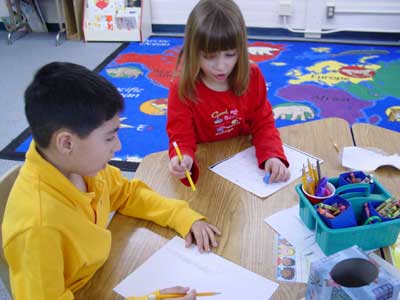
In addition to recognizing that each student is
an individual, I must recognize that each child has individual
needs. As their
teacher, I will create opportunities for all students to be successful
and I will ensure that education is accessible to all. Through
differentiated instruction, I will to make the curriculum accessible.
During my student teaching experience, I was able to teach using
differentiated instruction because of the range of students’ abilities
that were present in my classroom. As a result of my special
education experience in the Special Education/Teacher Education
Program,
I was able to modify instruction to accommodate learners with
special needs in my classroom as well as accommodate those students
who
needed a more challenging task. I used formal and informal assessments
as an instructional tool as well as a monitoring tool for my
students, which I will continue to do in my own classroom. Children
are individuals
who all have individual needs. As their teacher, it is my responsibility
to be aware of these needs and do my best in meeting them.
Engaging, challenging and purposeful instruction.
While student
teaching, I was able to write narrative learning objectives.
Writing narrative learning objectives allowed me
to reflect not only on what I wanted my students to learn,
but also how I would, as their teacher, guide them in the learning
process. During student teaching, I created lesson plans that
were both engaging and challenging for all my students, and
that
featured purposeful using narrative learning objectives. In
my future classroom, I will instill in my students that what they
are doing in school is relevant to their lives. I will spend
time with my students discussing ways in which they are able
to use these skills in the future as they get older and continue
with their education beyond elementary school.
I will motivate
my students with lessons that will engage them in learning each
subject. Rather than scripting my lessons with
every detail, I will provide opportunities and experiences
that my students will remember and encourage flexibility to address
their own interests. I will create instruction that is challenging
for all my students so they are able to problem-solve with
one
another find effective solutions. Through Vygotsky’s
theory of gradual release of responsibility, I will provide
appropriate
modeled, guided and independent practice opportunities to my
students. By having engaging, challenging and purposeful instruction,
students
will become accountable for their own learning and success
in school. Additionally, creating and conducting assessments
that
are authentic
and equitable along with instruction provides a measurement
of student progress, as well as my instructional methods.
Schools
serve as places in which students are given skills
to develop emotionally, socially and academically that allow
them
to become
part of the larger community outside of school. “Schools
must contribute to the social and emotional development of
the child if they are to fulfill their function of education
for life
in a democratic community and for fruitful family life” (Bruner,
1977). My role as their teacher is to foster an environment
in which students are able to grow and develop. By creating
a positive
learning environment, recognizing and respecting my students
as individual learners, and providing engaging, challenging
and purposeful
instruction for all my students, I will ensure their successes
and triumphs. In my future classroom, these core beliefs will
be demonstrated daily through my classroom management, lessons,
assessments
and overall learning environment.