Entry Slip Title: Instructional Modifications
and Accommodations
Title of Artifact: Independent
case study, lesson plan, cooperating teacher’s observation,
student work
Context: The attached
artifacts are part of an instructional intervention case study
that was conducted during my student teaching experience. As part
of the SPED/TEP program, I chose to conduct an independent study
focusing on assessing students’ needs and teaching with appropriate
instructional accommodations and modifications based on assessments.
This case study is a closer examination of one student in my classroom
and the growth she had over the course of six months as a result
of these modifications and accommodations.
UW Goals and Targets:
Goal 2: CREATING A POSITIVE LEARNING ENVIRONMENT
Learning Target 2B: Adapting for Differences
In the enclosed lesson plan, I have demonstrated
an understanding of how students differ in their approaches to
learning. The artifact
titled, “Case Study” demonstrates how I adapted this
lesson, instruction, and assessment to meet the needs of diverse
learners in my classroom. Specifically, I chose to focus on a
student with special learning disabilities.
Learning Target 2D: Assessment of Development
I used formal and
informal assessment strategies to ensure the continuous social,
emotional and physical development of learners.
At the beginning of the school year, along with my cooperating
teacher, I assessed students that allowed me to learn about
their current reading and writing levels.
GOAL 4: PROFESSIONAL COMMITMENT
Learning Target 4A: Teamwork with
Colleagues
I worked closely with my cooperating teacher in writing lesson
plans in order to ensure that activities were appropriate for
all the learners in the classroom. Additionally, we worked
closely
with our special education teacher to ensure we were making
appropriate accommodations and modifications for students with
special needs
in our classroom.
Reflection
To get to know every one of your students well
is a task that all teachers must accomplish during the school year.
I believe that as a teacher, my job is to know each of my students
and to recognize each of them as an individual. I strongly believe
that every child is successful, and it is my responsibility as
their teacher to ensure that they are given opportunities to be
successful. Thus, as their teacher, I must be prepared to adapt
plans and activities so every child can succeed to his or her fullest
potential. During my student teaching experience, I felt as though
I needed to learn more about my students. In order to become familiar
with my students, I conducted academic assessments at the beginning
of the year with my cooperating teacher. These assessments allowed
me to learn what students already knew and helped serve as a guide
to how I would plan my future lessons. I also collected students’ work
each month as an additional assessment of their development.
One
of the many responsibilities of teachers is to know their students.
In my student teaching classroom, there is a very diverse group
of students this year.
There are special education students, typically developing students, English
language learners (E.L.L.) and several highly capable students. According to
my cooperating teacher and her observation notes, I was able to adjust the
lessons to fit the needs of individual children.
As a result of knowing my students, I was able to differentiate instruction
and create engaging and challenging lessons for them. Through differentiating
my
instruction, I created opportunities for all my students to succeed to the
best of their capability. Willis and Mann write, “Differentiated
instruction is a teaching philosophy based on the premise that
teachers should adapt instruction
to student differences. Rather than marching students through the curriculum
lockstep, teachers should modify their instruction to meet students’ varying
readiness levels, learning preferences and interests, (Willis and Mann, 2000,
p. 256). Differentiating my instruction to my students allows me to ensure
that they are a step closer to achieving success.
Practicing differentiating instruction
allows me to step back and think about
what each of my students’ strengths and needs are. In the enclosed
artifact, titled case study, I was able to closely examine one student, Junie
(pseudonym),
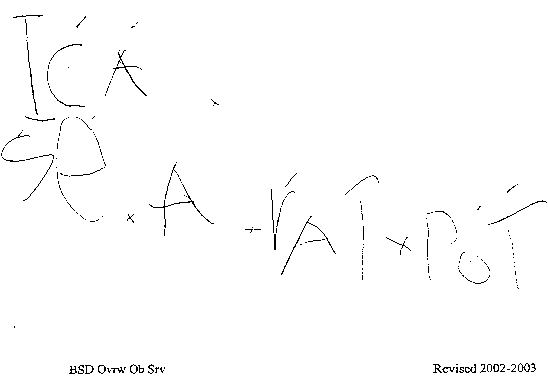
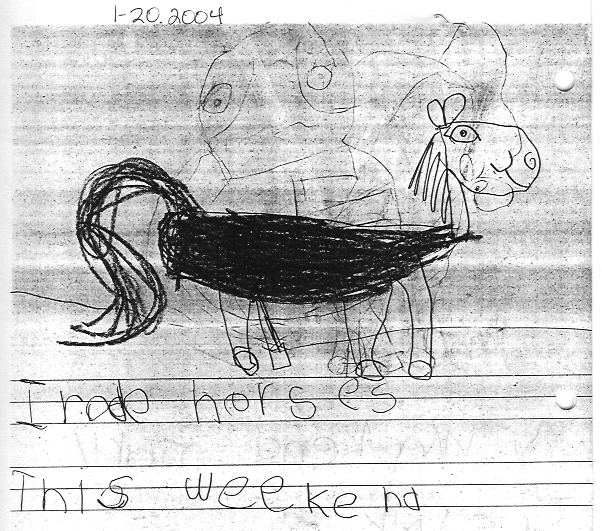
and her writing development. At the beginning of the year, Junie was performing
below 1st grade reading, writing and math levels. This case study highlights
the various writing interventions that my cooperating teacher and I tried
with Junie, with advice from our special education teacher. Many of these
interventions
ways of mediating scaffolding that act as temporary supports for students
to learn new material. According to Kame’enui, (1998), mediated scaffolding
is important for students who many not profit from traditionally sequenced
and structured curricula. In mediated scaffolding, teachers give personal
guidance and support during initial phases of learning new and difficult
information,
often through modeling and feedback.
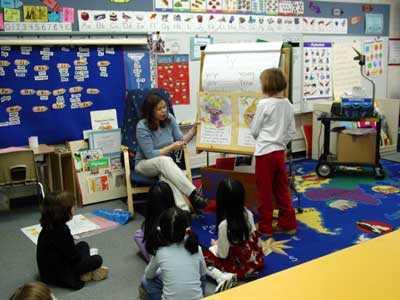
This particular case study allowed me
to collaborate closely with my cooperating teacher and special education
teacher, as I plan to do in my future school
setting. I was able to experience first hand the special education process
and learn how
to make modifications and accommodations in the general education classroom.
For example, I helped my cooperating teacher assess Junie, along with the
other students in the class, to see if any students needed further evaluation.
As
a student teacher, I have become familiar with what general education teachers
need to prepare and contribute to the process of adapting for different
learners, including those students with special needs. As a teacher,
I will need these
skills to adapt instruction for the individual learners that are in my
classroom.
Participating in assessments at the beginning
of the school year helped me prepare for the types of instruction
I need
to provide my students throughout
the school
year. Throughout the school year, I continued to assess my students in
order
to gain further understanding of what they individually need in order
to succeed, as I did in Junie’s case. By collecting weekly
writing samples of students’ work
(please see artifacts titled Student Sample 1,2, or 3), I was able to
determine if the interventions were successful or if changes needed
to be
made.
We adjusted these
interventions
as needed, scaffolding
more and gradually releasing this scaffolding to increase Junie’s
independence. I am sure that I will have students like Junie in my future
classrooms. The experience
I had during student teaching has provided a strong foundation not only
for me as a teacher, but for my future students. I feel as though I have
a stronger
understanding of students’ learning and development, and how I,
as their teacher, can provide opportunities for them to learn and develop
successfully.
Teaching and learning is a process—for both students and teachers.