Entry Slip Title: Using social circles for equitable
classroom management
Title of Artifact: Classroom
Management Paper, Lesson Plan on Teaching Norms
Context: The following
artifacts are: a paper that was written during my fourth quarter
of the teacher
education program in the class, Instruction of Students with Social
Behavior and a lesson plan that was used in a social circle
lesson. The paper was written in conjunction with our September
experience, prior to beginning our full time student teaching.
This paper gave me an opportunity to continue exploring the topic
of classroom management including: the physical layout of my future
classroom, issues that I may encounter as a future teacher, ways
of communicating within my learning community and the types of
consequences that I might use for misbehavior. In my future classroom,
I will create a positive learning environment through my communication
strategies and classroom management practices through which students
can practice democratic ideals.
UWTEP Goal(s) and Target(s):
GOAL 3: CREATING A POSITIVE LEARNING ENVIRONMENT
Learning Target 3A: Communication Strategies
I strive to communicate
effectively with all my students in order for learning to take
place. I implement effective verbal and
nonverbal communication techniques that encourage students
to work effectively as individuals as well as in groups. The attached
artifact titled "Classroom Managment Paper" displays the types
of verbal and non-verbal communication techniques that I will use
in my future
classroom.
For example,
in my parent letter and lesson plan to teach norms, I have
communicated
my expectations clearly. Additionally, in my lesson plan, I
have used inviting, inclusive and supportive approaches to questioning.
I believe that communicating to parents my philosophy of classroom
management not only lets parents and families know my personal
beliefs about classroom management, but also helps them become
aware of what our classroom will look, feel and sound like.
Learning Target 3B: Classroom Management:
Through my beliefs in classroom management, I have outlined ways
in which I can
encourage my students to work effectively as individuals and
groups. At the beginning of the
school year, I will clearly establish expectations for behavior
to help students work effectively. I
will engage my students in the creation of classroom rules and
expectations to help them take
responsibility for a positive learning environment and their
own behavior through social circles.
Additionally, as written in my paper, I will use strategies that
reinforce behavior conducive to
learning by using positive discipline strategies. Finally, I
will communicate with students’ families my personal approach to classroom environment.
Reflection
In my future classroom, I will create an environment
in which democratic ideals are being practiced and recognized by
all my students. When you walk into my classroom, you will feel,
see and hear the sound of a learning community. A soft murmur will
be heard as children collaborate with one another, ask questions
of one another and cooperate with each other to complete tasks.
This classroom community is one that is shared and respected by
all who reside in it.
In order to nurture an environment in which
democratic ideas are being practiced and recognized by all my
students, a safe and comfortable environment must be
established. As stated in my philosophy statement, I believe that students
need a place where they feel safe to be themselves. One vehicle
through which this
feeling of security and belonging, as well as respect for democratic ideals
can be practiced is through social circles, similar to what William
Glasser (2000)
would refer to as classroom meetings. He writes, “The concept of classroom
meetings is [where] teacher and students jointly discuss, and find solutions
to, problems of behavior and other class matters.” (Glasser, 2000, p
26).
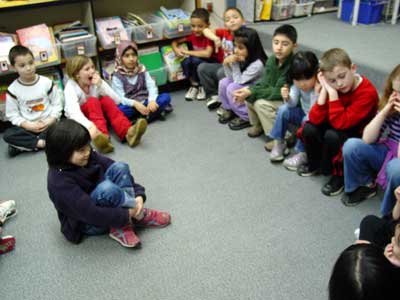
In my student teaching classroom, I was able to
create social circle times at least once per week, which I will
continue to do next fall. Social circle
approaches
introduce topics such as cooperation, understanding other points of view,
sharing, how other people feel, and problem solving. These skills,
according to my principal
are, “basic skills that are a foundation for school life and are embedded
in the classroom every day,” (Peiffer 2004). As a class, we role-played
situations in which students showed ways we can respect one another, our
space and our classroom. We also role-played social situations that may have
occurred
in the playground as well as in the classroom. This allowed students to engage
with one another democratically. Since I hope to teach in a primary setting,
my classroom meetings will closely resemble the social circles that we had
during my student teaching experience. Using social circles as a framework
for discussion
allows for a democratic classroom to emerge.
Additionally, social circles
allow a forum for my class to revisit our classroom norms, (please see
artifact labeled “lesson plan on teaching norms”).
In my future classroom, formal and informal rules will be in place
that
we will create
as a classroom. At the beginning of the school year, my students and I
will meet
to discuss ways in which we can all learn. I believe that involving my
students in the decision-making process provides a safe environment
in which they
feel included. Students are able to feel as they are part of the classroom
community,
a need that I feel as their teacher I must meet. Charles writes, “….students
sense belonging when they are involved in class matters, receive attention
from the teacher and other, and are brought into discussions of matters
that concern
the class,” (Charles, 2002, p. 38). This is similar to what was established
in my student teaching classroom, my cooperating teacher brainstormed with
her students
ways in which they could all learn. I revisited these expectations through
social circles while I was student teaching.
In today’s society,
there are numerous expectations. As citizens of this society, we must
learn about and adhere to the principles that define the roles
of our society. Classrooms serve as a foundation for these principles,
thus classroom serve as a forum for students to engage in democratic
practices. “It
[school] is the first real exposure to the public arena. Children are
required to share
materials and teachers in a space that belongs to everyone,” (Paley,
1992, p. 21). For example, if misbehavior occurs in the classroom, there
are consequences. If students do not respect the classroom and all who
reside
in it, the
sense
of community may deteriorate. Similarly, in society, when citizens do
not abide by laws, they may experience negative consequences. I hope
to establish
this
sense of democracy in my students in my primary classroom through social
circles and daily practices.
As I reflect back on my student teaching
experience, I recall what my cooperating teacher said to me about classroom
management. She said, “Classroom management
is the one of the toughest things to do as a teacher.” I am aware
of this challenge, and I strive to continue to fine-tune ways of managing
my classroom.
I believe that all children can learn and develop in our classrooms.
Our responsibility as educators is to provide a nourishing and organized
environment in which children
can grow. In my future classroom, social circles can help create this
environment. Recognizing that children have needs and feelings is important
in creating a
positive learning environment. Jones and Jones write about the overall
classroom environment, “The blending of caring and order both
helps meet students’ personal
and academic needs and is essential for teachers to meet their obligation
to create a safe and positive learning environment,” (Jones and
Jones, 2001, p. 57). I believe that this is a core aspect of fostering
classroom management. I will
continually revisit my classroom management plan and understand that
it may be revised depending on my students’ individual needs.