Entry Slip Title: Balanced
Literacy and Assessments
Title of Artifact: The
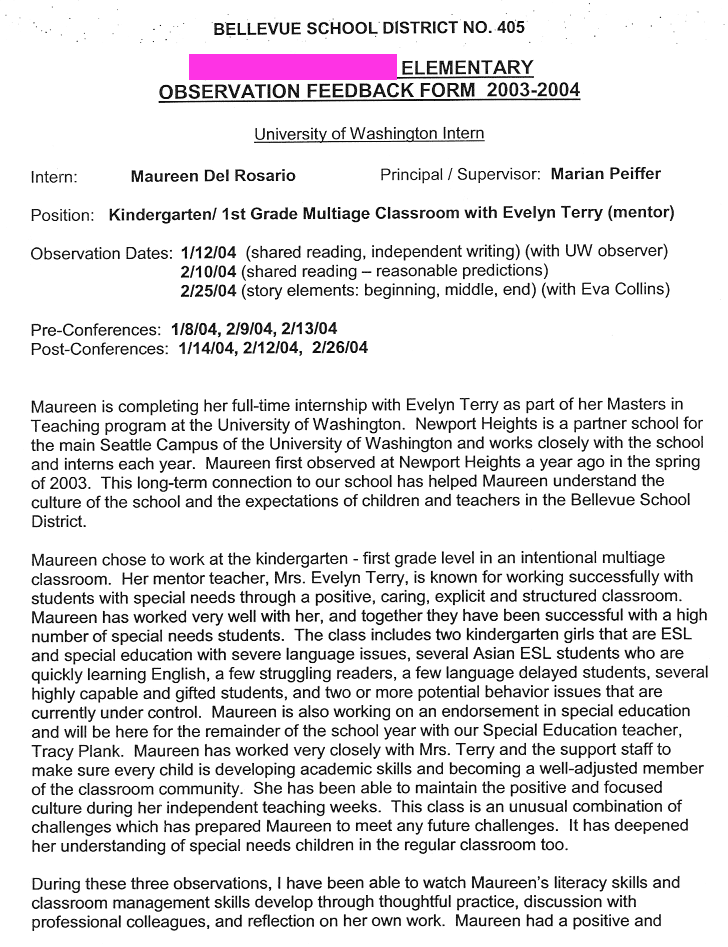
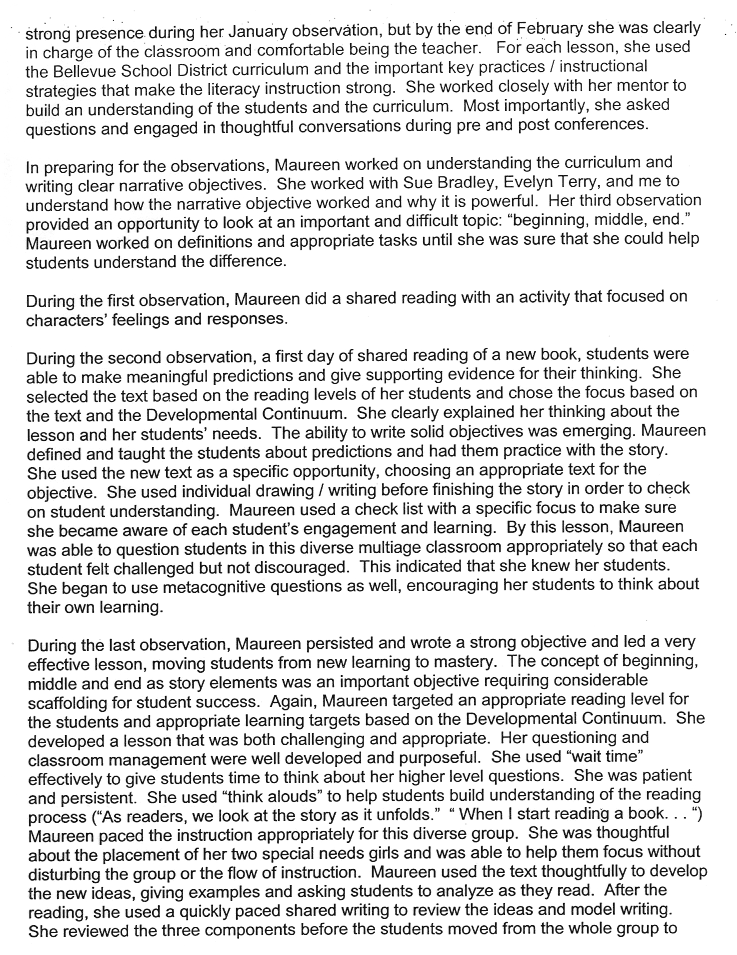
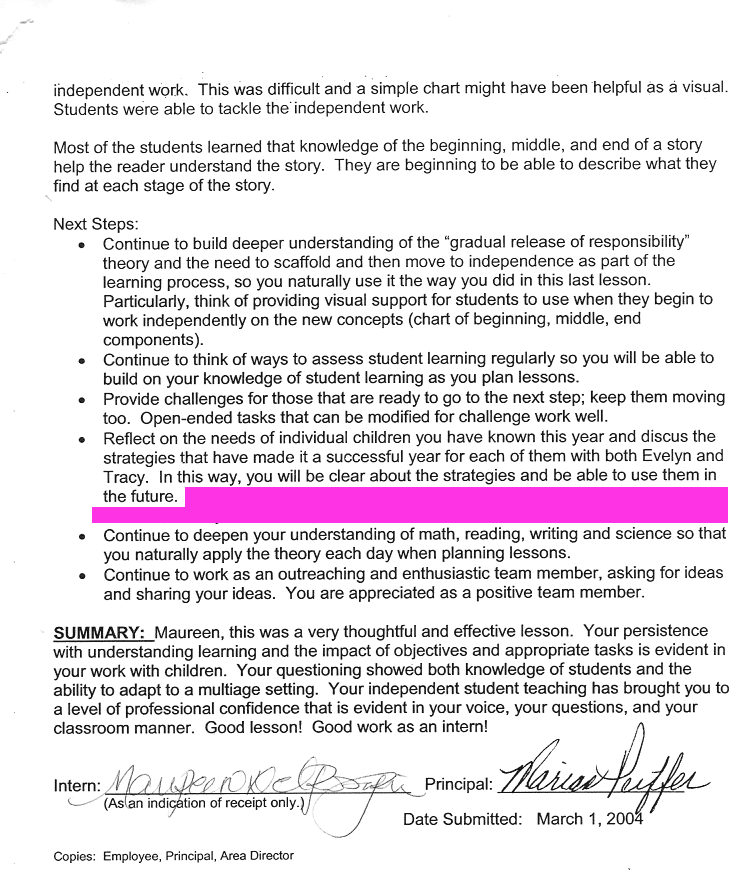
Meanies’ Trick: Shared Reading and Writing Lesson, assessment
rubric and notes, principal’s evaluation
Context: The following
artifacts include: a lesson plan for a week-long literacy unit
that I taught in February during my student teaching experience.
Specifically, this lesson is from the second day of the week-long
unit in which the students were instructed to focus on the concept
of beginning, middle and end in stories. I used the big book, The
Meanies’ Trick, by Joy Cowley for this shared reading
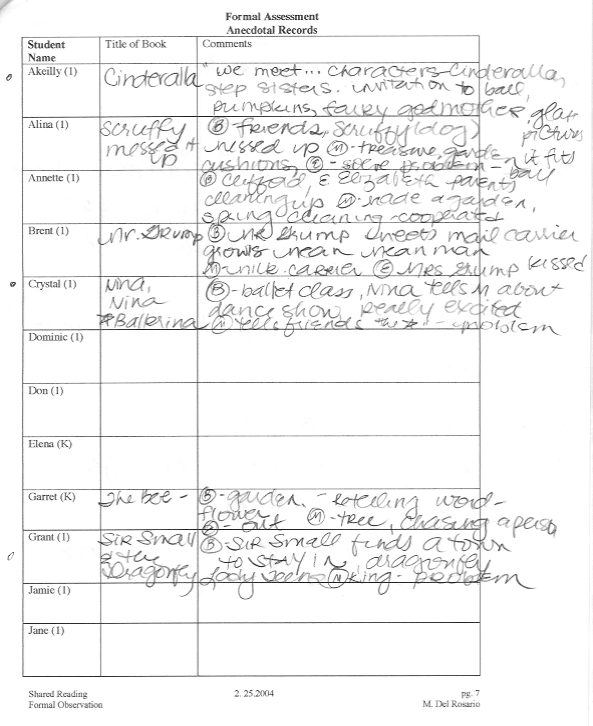
and writing. Attached are also an assessment rubric and notes and
principal’s evaluation.
UWTEP Goal(s) and Target(s):
Goal 1; Effective teaching assessment/evaluation
Learning Target 1B: Instructional Strategies
The artifact entitled, “evaluation,” illustrates that
I have used a variety of instructional strategies and meaningful
routines, activities, materials and resources that support learners
and their development of central concepts, thinking and inquiry
strategies, dispositions, and strategies in communicating in literacy.
My instructional strategies are based on Vygotsky’s gradual
release of responsibility. Gradual release of responsibility begins
with mainly teacher scaffolding which becomes less as students
are more exposed to a concept until eventually, students are independent
at this concept.
Learning Target 1D: Subject Matter Assessment
In my assessment, I have demonstrated understanding of how to
use formal and informal assessment strategies. I used them to evaluate
and support learners’ development of concepts and thinking/inquiry
strategies of communicating in the disciplines. Both my formal
and informal assessments stem from the Bellevue reading and writing
continuum, as well as the Washington state EALRs. I have designed
assessments that can be used to obtain information about my students’ progress.
These assessments provide information about my learners’ progress
to help me assess my own instruction. I involved my students
in evaluating their own learning at the end of the session. From
the results of both the informal and formal assessments, I provided
feedback about progress and give help to my students when needed.
These suggestions were direct, concrete and attainable by my
students.
Reflection
 |
“Oh, you are going to teach beginning,
middle and end; to kindergartners and 1st graders?” is the
question that intermediate teachers were asking me as I began to
prepare for an important shared reading and writing lesson for
my students. I enthusiastically replied to each teacher, “Yes,
I sure am!” My principal, cooperating teacher, university
supervisor and I were all aware of how challenging the concept
of beginning, middle and end is to grasp for kindergarten and first
grade students, however I was determined to teach a lesson that
would help my students begin to become familiar with this challenging
comprehension concept. Throughout the process of planning this
lesson, I struggled with how to teach this concept and also struggled
with conducting appropriate assessments for this lesson. How could
I modify my instructional strategies in order for my students to
succeed in beginning to understand this concept? What types of
scaffolding would I be using since my students all had various
levels of understanding of the concept? Furthermore, what types
of appropriate assessment should I use in order to fairly monitor
my students’ understanding?
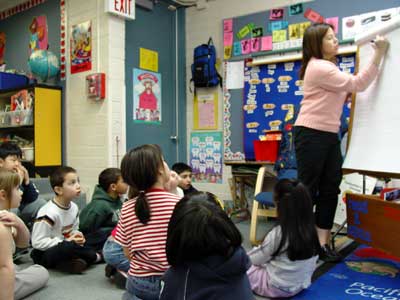
I wanted to share my love of literacy
with my students by going beyond the words they read on the page.
I wanted them to have the
tools necessary for them to comprehend stories that they read
by looking closer at the various parts of the story-the beginning,
middle and end sections. Comprehension instruction is a crucial
aspect of the teaching process and children need comprehension
skills to make sense of the texts they read. “Comprehension
has a central role in constructing the network of strategies
that are the foundation of self-extending system" (Fountas and
Pinnell,
1996, p. 156). This important concept is something that I believe
will be useful for my students in the future texts they read
in any
subject area. Their ability to retell and respond to the story
is a way for me to assess their comprehension of the text. The
students have worked on identifying characters and settings,
and they have created story maps through shared writing throughout
the year. Students have also worked on beginning, middle and
end,
but have yet to use this story structure in their retelling,
comprehension, and writing stories. At the time of teaching this
lesson, identifying
the beginning, middle and end was still a new and developing
skill for my students.
While meeting with my principal prior to
teaching this lesson,
she guided me to Vygotsky’s theory of gradual release
of responsibility. According to Vygotsky’s theory of
gradual release of responsibility, children need a great deal
of support
at the beginning of learning a new concept. Gradually, this
support becomes less through a shared activity, interactive
activity,
and finally children become independent at this particular
skill. I
planned this lesson hoping that students could become more
skilled at retelling and comprehending the stories they read.
This theory
served as a foundation for my instructional strategies throughout
this lesson and continued throughout my student teaching.
What
I found interesting is that this release of responsibility
differed between the students in my classroom throughout the
lesson and beyond. For example, for
some of the first graders, I needed to provide very little scaffolding. These
students were already working independently at sharing answers and correctly
identifying beginning, middle and end. In essence, they become more responsible
for their won learning. With other students, I continued to provide scaffolding
through guided practice and minimal prompting. For a few students, I needed
to continue providing scaffolding by working with them in smaller
groups and individually
in order for them to begin grasping the concept. As a result of this specific
instructional method, each student was on his or her road to understanding
this challenging concept.
While teaching this lesson I realized
how, ultimately, instructional strategies and assessments go
hand-in-hand. While assessing
my students during whole group
instruction, I was able to immediately identify which students were struggling
and also which students were beginning to work independently at this comprehension
skill. During formal assessment, I was able to delve deeper into students’ understanding
of this concept. Through Vygotsky’s theory of gradual release of responsibility
and the assessments I used, I was able to plant seeds in my students. Some
students’ seeds
grew immediately with nurturing, some needed a little time and a little more
nurturing, and even a few more needed more time and much more nurturing.