Entry Slip Title: Quilt
Squares and Block Towns-Planning a Math Unit on 2-Dimensional and
3-Dimensional Geometry
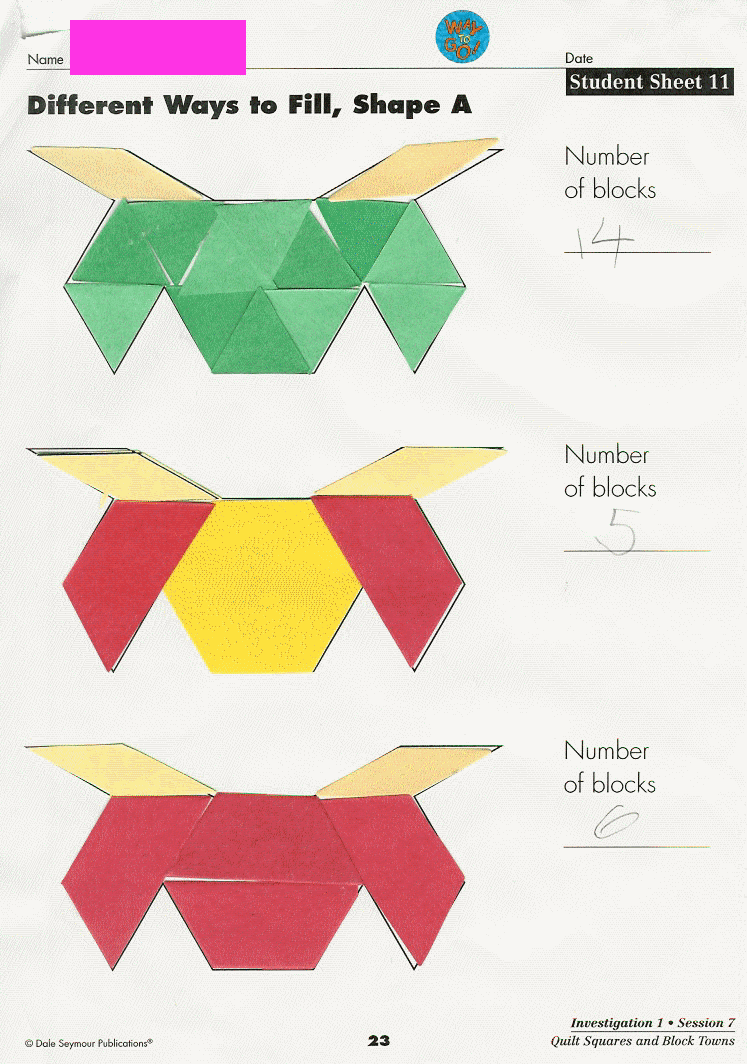
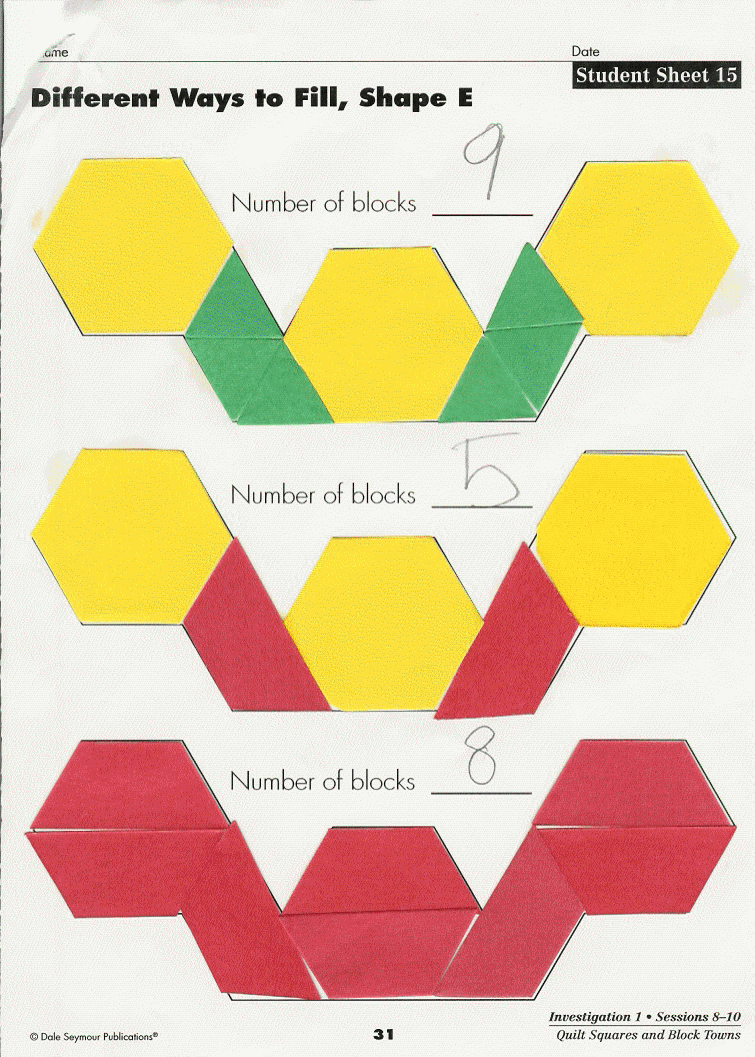
Artifacts: Unit
Calendar, sample lesson plan, evaluation, samples of student work.
Context: During my student
teaching experience, I was able to teach the 1st Grade TERC mathematics
unit entitled Quilt Squares and Block Towns. While I taught in
a kindergarten/1st multi-age classroom, mathematics was taught
by grade level. The kindergarten students in my class went to another
teacher for math instruction, and 1st graders from another class
joined the 1st graders in my class. Teaching a whole unit allowed
me to convey my passion for teaching a subject and to plan accordingly.
UW GOALS and TARGETS
GOAL 1: Effective Teaching, Assessment and Evaluation
Learning Target 1A: Subject Matter Knowledge
The
enclosed artifacts (unit calendar and sample lesson plan) demonstrate
my deep knowledge of subject matter, including my understanding
of mathematics concepts, and thinking and inquiry strategies.
The written plan has objectives that support the Washington
state EALRS. My learning objectives are tied to the geometry unit,
context, learners’ long-range curriculum goals, and student
needs.
Learning Target 1C: Planning
In planning and teaching this unit, I incorporated subject matter
knowledge, students, community, and curriculum goals. The learning
objectives that I set forth are clearly tied to the EALRS,
and the lessons are organized in a logical sequence of learning
activities,
which provided scaffolding learning experiences. While planning
this lesson, I incorporated a variety of instructional strategies
and meaningful routines, activities, materials and resources
to support learners and their development of central concepts,
thinking and inquiry strategies, dispositions and strategies
in communicating in mathematics. There are guided and independent
practice opportunities for students.
Reflection
When my cooperating teacher informed me that
I would be teaching the geometry unit during my student teaching
experience, my body tightened. I have always enjoyed mathematics,
but I struggled with geometry in school. I just couldn’t “see” the
concepts clearly, and this inability to actually visualize concepts
inhibited my understanding of geometry. Thus, I needed to gain
additional knowledge of geometry in order to effectively teach
my students the subject. I also needed to plan a whole unit that
addressed all my students’ needs. During the end of autumn
quarter, I re-taught geometry to myself by reading through the
TERC manual and discussing the topic with my math instructor at
the university and my cooperating teacher.
During winter break,
I immersed myself in the Quilt Squares and Block Towns teacher’s
manual. While reading through the three different investigations,
I became aware of the importance of building
children’s knowledge about a subject. For example, the unit
begins with exploring two-dimensional geometry and probing students’ understanding
of the various shapes we encounter throughout our lives. After
spending a few weeks on exploring two-dimensional shapes, we were
to explore three-dimensional shapes. I asked myself: Would students
easily make connections between two and three-dimensional shapes?
If students were not understanding the concept of two dimensional
shapes, how would I be able to help them reach a higher level understanding
of three-dimensional objects? Would they be able to compare and
construct various three-dimensional shapes?
Both my cooperating teacher and my mathematics instructor reminded
me of the importance of my role as these children’s teacher.
One of the most important tasks I have is to give my students
essential tools and instruments to guide them to their understanding
and
success. I needed to plant geometry seeds in their heads and
water these seeds with guidance. I needed to facilitate learning
in a
way that information was coming from my students. As a result
of my own experience with geometry as a young child, I felt as
though
I needed to hold my students’ hands and guide them each
step of the way in order to ensure success. After talking with
my cooperating
teacher and instruction and realizing this contrast, I became
more confident in teaching geometry to my students. I spent time
brainstorming
situations that might arise within my math classroom, and concepts
my students might be successful with or struggle with, and I
tried to anticipate other “what ifs”. These were
all factored into my lesson plans. When January arrived, I was
excited to share
this new-found passion for geometry with my students and even
more excited for them to teach and learn from one another.
One
of my core beliefs as a teacher is to provide engaging instruction
with purpose. I wanted my students to realize that geometry
is important beyond the boundaries
of school and I wanted my students to enjoy what they were learning. All
the skills they would learn would be applicable to their lives
in various ways.
Jerome Bruner (1975) states, “The first object of any
act of learning, over and beyond the pleasure it may give,
is that
it should serve us in the future. Learning
should not only take us somewhere; it should allow us later to go further
more easily,” (Bruner, 1975, p. 63). While planning this
lesson, I needed to set some time during lessons as a class
to discuss
the importance of geometry and how
this skill is used daily by everyone. I was pleasantly surprised that my
students were able to carry this discussion throughout the
unit, and remind each other
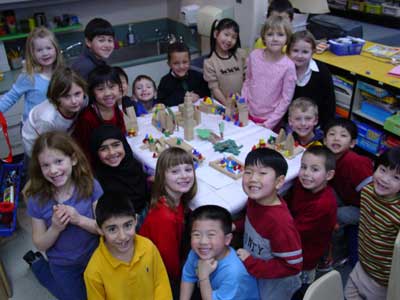
of why we were doing the things we were doing. Students discussed architecture,
planned a city and “how much stuff” to use, and connected these
concepts with geometry. This discourse allowed me to press for students’ understanding
and encouraged them to become accountable for their own learning. Two and
three-dimensional geometry is a challenging concept for many young children
to comprehend. But
I believe that the way in which I engage our students in this subject plays
an important role in their understanding of geometry as well as any other
subject or concept.
Through careful planning, I was able to address
my students as individual
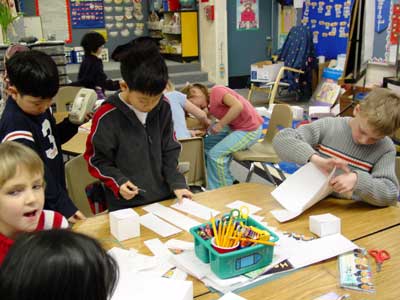
thinkers. I planned a variety of individual, paired, and group activities
to address
students’ development,
all including an opportunity for them to communicate with one another,
with me, and with the rest of the class about their thinking and understanding.
For example,
my students could talk with me in mini-conferences or present a poster
or
drawing or something they built with the rest of the class. Communicating
their thinking
encouraged the children to think about or reflect on their learning and
what they accomplished. Additionally, it also encouraged further understanding
of the concepts. Finally, communicating their thinking also allowed me
to
assess
their understanding.
The time I spent carefully planning this unit
and re-teaching myself about geometry helped my students become
successful in these geometric
concepts.
It became apparent
as they discussed with one another, built their own three-dimensional
shapes, built our classroom town and from the smiles on their faces.
This experience
reinforced the importance of careful preparation and subject matter knowledge.