Title of Artifact: Studying the Learning Community:
Looking at ways in which teachers create learning communities.
Context: The following artifact is a paper that was written during
my first quarter of the teacher education program in the class,
Dilemmas in Teaching and Learning. Written in conjunction with
our second field experience, this paper gave me the opportunity
to continue exploring questions about students, learning, and the
design of learning communities. Our class assignment was to identify
a question about intellectual communities in the classroom. My
specific question was: How do differences between teachers’ types
of reinforcement impact student participation in small and large
group activity in a learning community? This question interested
me because I was curious about how teachers manage small groups
and large groups. The observation took place in a first grade classroom
in a very diverse population.
UWTEP Goal(s) and Target(s):
GOAL 2: MEETING THE NEEDS OF DIVERSE LEARNERS
Learning Target 2A: Learning and Development
While writing
this paper, I began to develop a deeper understanding of how
students learn and develop. I observed ways in which teachers
created and provided learning opportunities that supported
the intellectual, social and emotional development of their students.
It was beneficial for me to observe because it provided a strong
foundation for how I would create lesson plans with clear objectives,
activities, and assessments to address the developmental needs
of learners. This artifact demonstrates my understanding of
children’s
learning and development. Finally, this artifact addresses
how I will use this understanding of children to teach my future
students effectively.
Learning Target 2C: Respect for Learners
This paper supports
my belief that, as a teacher, I have an obligation to have respect
for learners as thinkers and as individuals and
to create a learning community in which individual differences
are respected. This paper also promotes my belief in creating
a supportive learning environment for my students. Finally, this
paper examines ways in which my respect for learners recognizes
their special talents as individual students.
Reflection
I was interested in examining how the differences between teachers’ types
of reinforcement impact student participation in small and large group activities
in a learning community. In my future classroom, I plan to combine a variety
of activities that take place in both small and large groups. According to
Sapon-Shevin, (1999), a community has the following characteristics:
security, open communication,
mutual liking, shared goals and objectives and connectedness and trust. Building
this type of community within my future classroom is crucial to me. I genuinely
believe first and foremost that teachers must establish a comfortable environment
that is conducive to their students’ needs--not just for academic learning,
but for building relationships, fostering social interactions, and for students
to become comfortable about sharing themselves with others.
During one of my
observations, I witnessed two varying types of instruction that resulted
in various behavior patters exhibited by students, which in turn
impacted
the overall learning community. In a small group led by a teacher, encouragement
and positive reinforcement were given to students, which resulted in an increase
in participation by students, thus forming an ideal learning community.
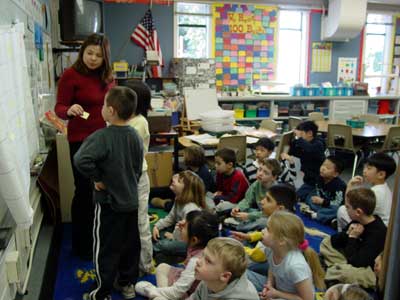
The
small group led by a teacher, Mrs. O, exhibited a few key aspects,
which I would argue contributed to a learning community. These
key aspects were
providing an environment that is comfortable, safe, and positive, as well
as one that
promotes collaborative effort. These key aspects, I believe, contributes
to a community
that is conducive to students’ learning and overall development.
In contrast, Mrs. M’s instruction seemed to inhibit students’ level
of engagement and as a result impacted their overall learning. The key
components of a learning
community found in Mrs. O’s group were absent in Mrs. M’s group,
which fostered a different type of behavior within the learning community.
One important difference between the two groups was the way in which mistakes
were
handled. In Mrs. O’s group, mistakes created an opportunity for students
to learn. For example, in one instance, a student read a challenge word
incorrectly. Rather than reprimanding the student for her mistake, Mrs.
O consistently
encourage her and gently asked her student to try again. The way in which
Mrs. O handled
this student’s mistake is supportive of overall learning processes
as Stigler and Hiebert (1998) argue. “Students will learn to understand
the process more fully, if they are allowed to make mistakes….” (Stigler
and Hiebert, 1998, p. 27).
In
contrast to Mrs. O’s instruction, the way Mrs. M handled her students’ mistakes
created a more negative environment, one with which students were not
able to learn as much. Rather, Mrs. M. put an emphasis on her students
making
mistakes,
and instead of assisting her students to learn from their mistakes, Mrs.
M. provided a platform in which she became the authority figure. In Kazemi’s
(1998) article, she writes about a teacher who did not press her students,
who instead
took control of the situation. “Ms. Andrew did not describe and
discuss collaboration…Neither individual accountability nor consensus
emerged as topics of discussion in whole-class activity.” (Kazemi,
1998, pg. 414). This illustrates Mrs. M as the authority figure who does
not
allow room for discussion
or her students’ voices to be heard.
The environment created by
Mrs. O is indeed the type of environment that contributes to the overall
community that Sapon-Shevin (1999) argues
is conducive to children’s
learning. It is important to take note that creating an environment
in which students feel free to share themselves with others, safe,
nurtured
and feel valued
as individuals foster a more cohesive learning environment. Mrs. O’s
students felt this way, and as a result were more willing to share
and were more engaged,
in contrast to the behavior they exhibited when they were in Mrs. M’s
large group. The students in Mrs. O’ groups were clearly more
excited to learn, motivate to try and learn, and were made to feel
competent
by the reinforcement
and encouragement given by Mrs. O. The way in which Mrs. O managed
her groups and her interaction with her students were more positive
than
Mrs. M’s
larger group.
As teachers, we need to motivate our students
to become critical thinkers about own education and understanding.
We, as teachers,
in essence,
become students
of our own students. Through all the readings and school observations
I have done in this program, as well as my past experiences with
children, I am
constantly re-evaluating my role as a teacher as well as what my
personal philosophy of
public schooling is. I know the kind of teacher I want to be, which
is constantly being tested with every relationship I form. I want
to be
a
teacher who fosters
my students’ learning and engagement with the world around
them. In order to do this, an environment in my classroom must be
created
that parallels democratic
ideals and beliefs. Among those that are important to me are trust,
civil discourse, and civic engagement, which were all present in
Mrs. O’s group. Those characteristics
are crucial in preparing our students to become active participants
in a democratic society.
I want to be a teacher who supports and motivates
my students to their fullest potential. I believe when my students
are surrounded
by a nurturing
environment
with an educator that allows them to grow and develop, they will
succeed. Students need to be in an environment that allows them
to make mistakes
and learn from
these mistakes. When these mistakes are made, my job as a teacher
is to gently guide and facilitate their learning from these mistakes.
As teachers,
we
must create an environment that will be conducive to our students’ growth
in our classrooms, but also in their development, as they become
participating and
engaging citizens of our democratic society.